

8647outnowpress
They Don't Give a Damn: How Big Tech Is Breaking Society and Betting You'll Be Dead Before It Matters
June 2026
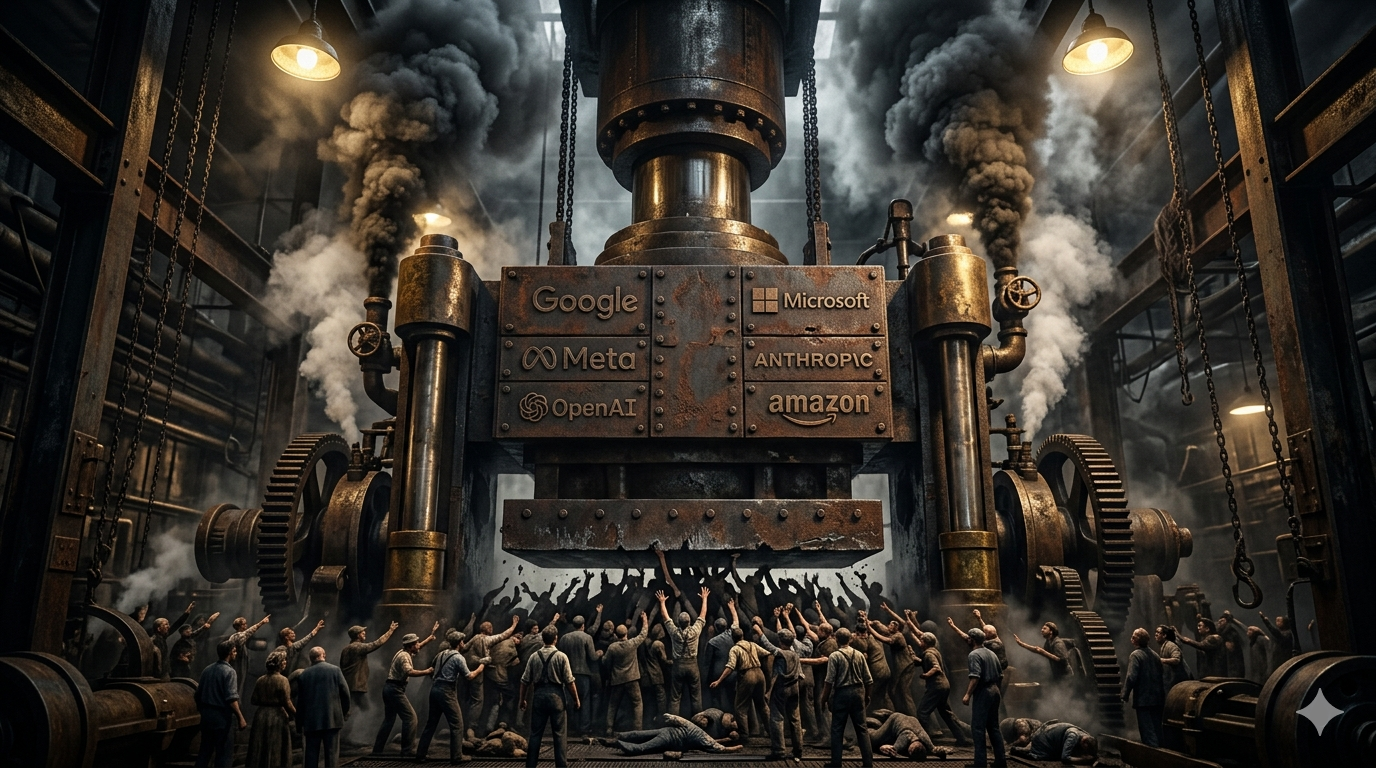
They released it anyway.
Not because it was ready. Not because it was safe. Not because anyone asked. They released it because investors wanted returns, CEOs wanted bonuses, and the quarterly report was due.
That is the story of artificial intelligence in 2026. Not the sci-fi version. The real one.
The Product Is Broken. They Know It.
AI hallucinates. It fills gaps with confidence instead of admitting uncertainty. It sounds authoritative while being wrong. It makes up legal citations, gives dangerous medical guidance, and produces code that crashes production systems.
These are not fringe cases. Gartner predicts that by 2026, 60% of AI projects will fail due to poor-quality data. McDonald's AI hiring platform exposed 64 million job applications through a test account with the password "123456." Confident. Broken. Shipped anyway.
Here is the business logic: release early, charge $20 a month per user, patch it later. They are not trying to fix it before launch. They are trying to recover their investment before regulators catch up. The customer is the beta tester. You are paying them to break it on you.
This is not innovation. It is extortion with a chatbot interface.
The Human Cost They Are Not Counting
In the first six months of 2025 alone, companies reported nearly 78,000 tech job cuts directly tied to AI adoption. Wall Street banks plan to eliminate approximately 200,000 positions over the next three to five years. Amazon cut 14,000 corporate roles and said AI enabled a "leaner structure." Workday cut 8.5% of its workforce to "reallocate resources toward AI."
The World Economic Forum says 92 million jobs will be displaced by 2030. McKinsey says today's AI, what exists right now, could automate 57% of current U.S. work hours. Not 57% of jobs. 57% of the hours. Think about what that means for the people doing those hours.
These are not abstract statistics. These are cashiers, paralegals, customer service agents, accountants, programmers, writers, and analysts. Real people with mortgages, kids, aging parents, and no runway.
The companies know this. They have the reports. They hired the economists. They read the same WEF data everyone else does. And they shipped the product anyway.
The Sociology They Are Ignoring on Purpose
There is a word for what happens when a society undergoes massive economic displacement without support systems, retraining, or a safety net. The word is collapse. Not dramatic collapse. Slow collapse. Anxiety. Addiction. Suicide. Political rage. Social fracture.
We are already watching it. AI adoption is accelerating anxiety about job security faster than it is actually displacing jobs. Deutsche Bank analysts warned that anxiety around job displacement will become far greater in 2026. People are scared now, before the full wave hits.
Tech companies are not holding town halls. They are not funding retraining at scale. They are not lobbying for stronger unemployment safety nets. They are lobbying for fewer regulations on themselves.
Here is the calculation they are making: the people most harmed by this transition are older. They will retire or die before the political pressure becomes unbearable. The younger generation will grow up with AI as a given and stop asking why it happened the way it did. Generational turnover solves the PR problem. It does not solve the human problem.
That is not a conspiracy theory. That is a business strategy.
The Software Is Telling You Who They Are
You want to know how much these companies care about the people using their products? Use them.
AWS and Azure, two platforms that underpin half the internet, have user interfaces that make basic tasks a multi-hour ordeal. Buttons that do not look like buttons. Navigation buried three levels deep. No onboarding. No documentation that matches what is actually on the screen. Trial and error as the intended workflow.
Anthropic's own Cowork product stores project files locally with no cloud sync, no documentation explaining this, and no warning when you try to access your work from another device. You find out when you are on vacation and your files are not there.
Microsoft ships Office updates that break workflows without warning. They bundle AI chatbots into tools people use for serious work without asking. Software quality has declined every decade since the 1990s because bugs at launch are now acceptable. It runs mostly. Good enough. Ship it.
Security? Thrown onto the consumer. Multi-factor authentication, authenticator apps, hardware keys, email codes, phone codes, fingerprints. Layer after layer of friction because companies will not build real security into the product. They hand you a padlock and tell you to guard the front door while they leave the back window open.
This is not incompetence. This is priority. When profit is the priority, user experience is an afterthought. When speed to market is the priority, quality is optional. When shareholders are the priority, society is a rounding error.
What Accountability Looks Like When There Is None
Research published in 2025 found that when AI causes harm, Big Tech companies only respond substantively when regulators force them to. When no regulation covers the harm, engagement is either absent or superficial. Ethics boards, responsible AI teams, and safety hubs are not accountability. They are press releases.
The EU AI Act assigns responsibility to developers and deployers. The U.S. has no equivalent. Congress cannot pass a budget. They are not regulating artificial intelligence.
So the companies do what unaccountable power always does. Whatever they want.
This Is Not About Technology
This was never about technology. It was about power and money, same as it always is.
The companies releasing these products are the same companies buying politicians, gutting unions, and writing the rules they claim to follow. They are not afraid of regulation because they write the regulations. They are not afraid of public anger because they own the platforms where public anger is expressed.
They released a product that will displace hundreds of millions of workers worldwide. They knew this. They did it anyway. And when the human cost becomes undeniable, they will fund a think tank to explain why it was necessary and inevitable, and why the people who got hurt should retrain for jobs that do not exist yet.
The sociology is not being ignored by accident. It is being ignored because acknowledging it would require slowing down. Slowing down costs money. People cost less than money costs.
Until that changes, nothing else will.